The Slow-Down Effect: Birding Isn’t Really About Birds
 Michael Mathews
Part four of Fledgling Files — a blog series for new birders who went outside to find birds and found something else entirely.
Nobody warns you about this part.
You go outside to look at birds. That’s the plan. You’ve got your binoculars, maybe a field guide, possibly a thermos of coffee because you read somewhere that good birding happens early. You’re focused. You’re ready. You’re going to find some birds.
And then, somewhere between the parking lot and the trail, something strange happens. Your shoulders drop. Your breathing slows. The mental list of things you were supposed to do today — the emails, the errands, the low-grade ambient anxiety that follows most of us around like a household pet — goes quiet. Not gone, exactly. Just quiet.
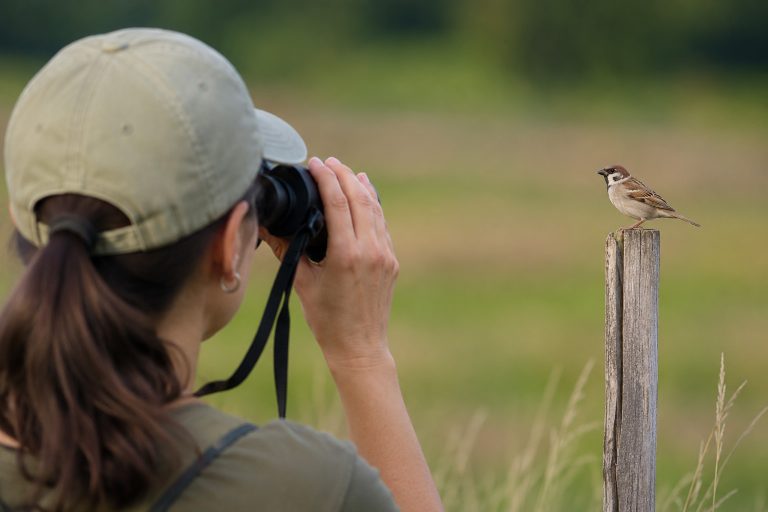
You stand at the edge of a meadow and watch a sparrow work through a seed head, and for a moment, that is genuinely the only thing happening in the world.
You came out here to find birds. Somehow you also found something else.
Why Birding Forces You to Stop
Most hobbies are forgiving of impatience. You can push through a workout. You can speed-read a book. You can play a video game at whatever frantic pace suits you and still get somewhere.
Birding will not allow this.
Birds are exquisitely sensitive to disturbance. Move too fast and they flush. Talk too loud and they go silent. Crash through undergrowth and the entire area empties out as if you tripped an alarm. The only effective strategy — the one that every experienced birder eventually internalizes — is to slow down, move deliberately, and wait.
This is deeply countercultural. We are not, as a society, good at waiting. We have engineered waiting almost entirely out of daily life, and then we wonder why stillness feels so unfamiliar when we encounter it.
Birding re-introduces waiting as a feature rather than a bug. You stand at the edge of a thicket and you watch and you listen, and the longer you do it, the more you see. A warbler that wasn’t there a moment ago. A rail creeping through the marsh grass. A hawk you would have walked right past. The world fills in around you when you stop moving through it at speed.
This is, it turns out, available to you any time. You just needed a reason to try it.
The Attention Economy, Interrupted
Consider what your attention looks like on a typical day.
Notifications. Tabs. The reflexive reach for your phone in any moment of stillness. The feeling that focus is something that happens to you in brief windows rather than something you direct. Most of us are swimming in information and starving for concentration, and we’ve gotten so used to the fragmentation that we’ve stopped noticing it.
Birding asks for something different. It asks for open, patient, sustained attention — the kind where you’re not looking for something specific so much as staying receptive to whatever appears. Not scanning, exactly. More like waiting with your eyes open.
This mode of attention is increasingly rare, which may be part of why it feels so striking when you access it. There’s a particular quality to the focus that birding produces — absorbed but calm, alert but unhurried — that’s genuinely different from the anxious, fragmented attention most of us navigate daily.
You can’t scroll while you’re watching a marsh. You can’t multitask your way to a warbler. The bird demands all of you, briefly, and in exchange it gives you a moment of being completely somewhere.
That’s not a small thing.
What the Research Actually Says
Scientists have been quietly building a case for what birders have known intuitively for years.
Studies on attention restoration theory suggest that natural environments — particularly those that engage our curiosity without demanding active problem-solving — allow the directed attention we use for work and decision-making to recover. Birding, which is engaging enough to hold focus but open-ended enough not to exhaust it, fits this description almost perfectly.
Research from the University of Exeter found that people living in neighborhoods with more birds reported higher levels of wellbeing, and that the effect held across income levels. A study published in Scientific Reports found that seeing or hearing birds was associated with improved mood that lasted hours beyond the encounter itself.
None of this will surprise anyone who has spent a quiet morning watching feeders. But it’s useful to know that what you’re feeling isn’t imaginary or sentimental. Something real is happening, measurably, when you go outside and pay attention to birds.
You’re not just birdwatching. You’re doing something genuinely good for your brain.
The Unexpected Community
Here’s the thing about birders that catches most newcomers off guard: they really want to help you.
Birding culture has, against all odds, remained remarkably generous and welcoming. Post an uncertain ID to a local birding group and you’ll get five thoughtful responses within the hour. Show up to a guided walk as a complete beginner and the experienced birders will point things out to you, explain what they’re seeing, and celebrate your first decent find as warmly as their own.
This isn’t universal — no community is — but it’s genuine enough to be one of the hobby’s best-kept secrets. Birders want more birders. They want to share the thing they love, and they remember what it was like to be starting out.
Local Audubon chapters run free or low-cost walks in most cities. eBird’s “Explore” feature shows you what’s been seen near you and who’s been seeing it — and those names are often people who would happily show you around. Online communities like Reddit’s r/whatsthisbird are patient and helpful in a way that internet communities don’t always manage.
You don’t have to do this alone. And you’ll be surprised by the people you meet when you stop staring at your phone and start staring at trees instead.
The Bonus You Didn’t Pay Extra For
Here’s the deal birding quietly offers everyone who takes it up:
Yes, you will learn birds. You’ll learn their names and their field marks and their songs, and that knowledge will accumulate slowly and then all at once until the world starts to feel annotated in a way it wasn’t before. That part is real and worth pursuing on its own terms.
But you’ll also get something else. Mornings that feel like they belong to you. A reason to be outside when you might otherwise not be. A practice of attention that carries over, subtly, into the rest of your life. The particular peace of standing somewhere and watching something small and alive do exactly what it was made to do.
The birds are worth knowing. But if this hobby also makes you calmer, more present, and a little more connected to other people and the world around you — well. Consider that a bonus you didn’t have to pay extra for.
And unlike the binoculars, it starts working immediately.
Last up in Fledgling Files: 900 species in North America, and why that number should excite you rather than send you back to bed.
About The Author