From Egghead to Airborne: The Many Names of Baby Birds
One of the first things new birders discover is that birds apparently go through more identity changes than a teenager trying out hairstyles.
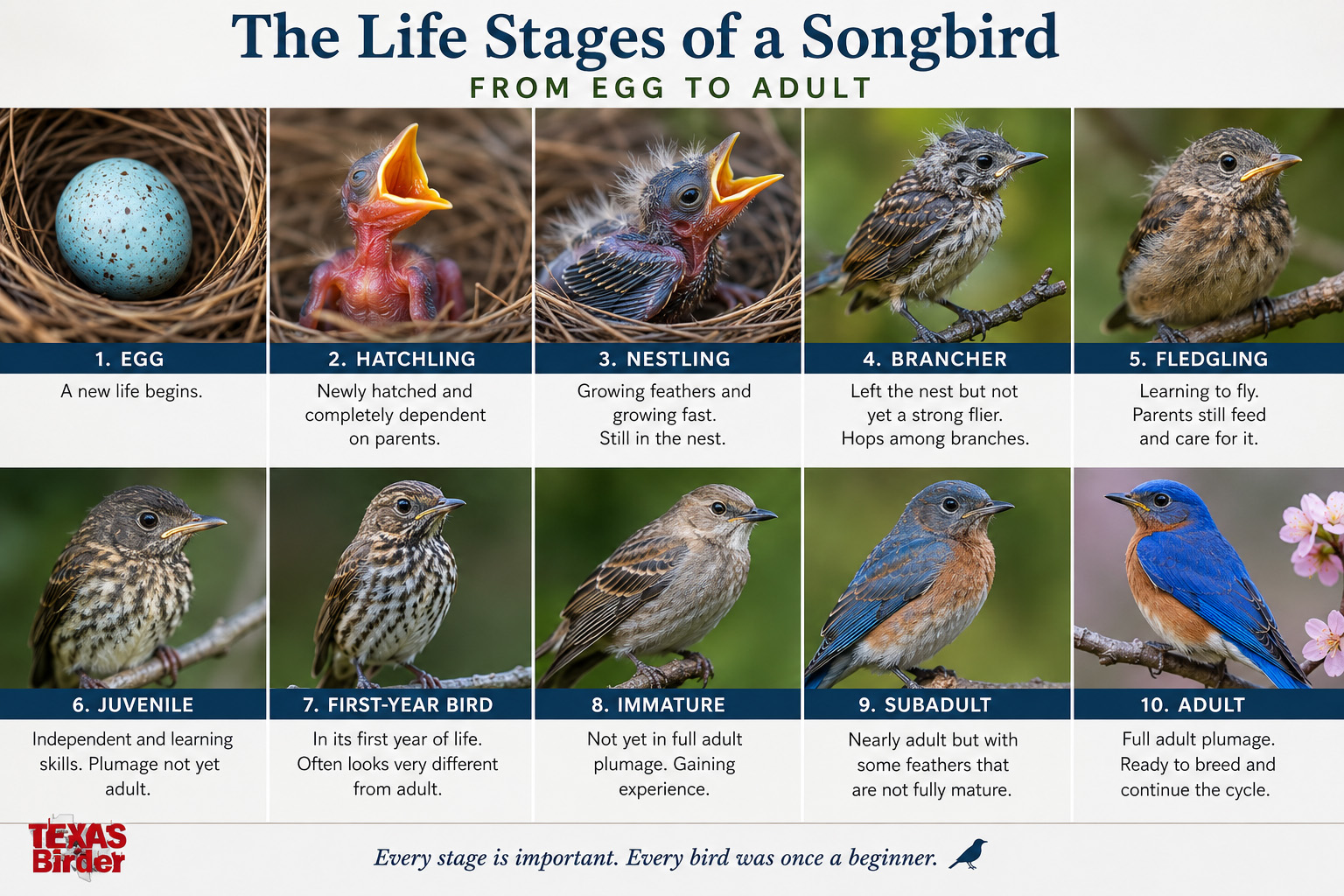
We start with an egg.
Then suddenly we have hatchlings, nestlings, fledglings, juveniles, immatures, first-year birds, second-year birds, and adults. It is enough to make you wonder if birds carry tiny driver’s licenses so they can keep track of where they are in life.
Let’s untangle this feathery soap opera.
Egg
This stage is pretty straightforward.
The bird is an egg.
It doesn’t sing. It doesn’t fly. It doesn’t eat at the feeder.
Its primary skills are lying still and making birders point excitedly from a respectful distance.
Duration: Depends on the species. A hummingbird hatches quickly. An eagle takes longer. Neither appreciates unsolicited parenting advice.
Hatchling
A hatchling is a bird that has just emerged from the egg.
This stage can best be described as:
“Looks nothing like a bird.”
Most hatchlings are pink, nearly featherless, and possess mouths so enormous they appear capable of swallowing the nest.
They spend their days doing three things:
- Eating
- Sleeping
- Screaming at their parents for more food
(Well, there is a fourth, but we won’t talk about that one)
Sound familiar? If you raised children, it should.
Nestling
Once the hatchling survives the early days, it becomes a nestling.
Nestlings remain in the nest and are still dependent on their parents for absolutely everything.
They begin growing feathers, although many look like they lost a fight with a pillow factory.
Their heads are too big.
Their tails are too short.
Their feathers stick out at impossible angles.
Bird parents somehow look at this disaster and think:
“Yep. That’s my beautiful child.”
Brancher
This is one of the lesser-known terms and one of my favorites.
A brancher is a young bird, usually a hawk, owl, or other tree-nesting species, that leaves the nest but is not yet capable of sustained flight.
Instead, it hops awkwardly among branches.
That’s a brancher.
If you find one, leave it alone.
Its parents know where it is.
The parents are probably nearby rolling their eyes.
Fledgling
This is the stage everyone loves.
A fledgling has left the nest and is learning to fly.
Notice I said “learning.”
Flying is not immediately elegant.
Fledglings crash into bushes.
They miss branches.
They land in flower beds.
They occasionally look stunned that gravity exists.
Meanwhile, their parents continue feeding them while trying desperately not to laugh.
A fledgling often has:
- A short tail
- Fluffy feathers
- Yellow corners on the beak called gape flanges
- A perpetually confused expression
The expression is universal.
Even bald eagles look bewildered as fledglings.
Juvenile
A juvenile bird is independent from its parents but has not yet reached adult plumage.
This is the bird equivalent of middle school.
Juveniles are capable.
They know how to feed themselves.
But they often dress terribly.
Many juvenile birds are streaky, blotchy, or plain looking.
The brilliant red of an adult male cardinal?
Gone.
The dazzling colors of a painted bunting?
Not yet.
Instead, Mother Nature hands them camouflage and says:
“Let’s survive first. Fashion can wait.”
First-Year Bird
We birders love precision.
A first-year bird is a bird in its first calendar year or first full year of life, depending on the species and the identification system being used.
This stage is especially important with gulls, hawks, and shorebirds because they may look dramatically different from adults.
Some species spend years getting dressed.
Take gulls.
A first-year gull often resembles a coffee stain with wings.
Second-year gulls are slightly improved coffee stains.
By adulthood they finally become respectable citizens.
Immature
Immature is a broad term for any bird that has not yet reached full adult plumage.
Think of it as the giant umbrella category.
All juveniles are immature birds.
Many first-year birds are immature birds.
Some eagles remain immature for four or five years.
Which means if you are waiting for an eagle to turn white-headed and majestic, you may need patience.
Lots of patience.
And snacks.
Subadult
Subadult is another term often used for birds that are nearing adulthood but are not quite there.
This is especially common with long-lived birds like:
- Bald Eagles
- Golden Eagles
- Large gulls
- Some herons
Subadults are close.
You can see hints of the final plumage.
It is like watching someone slowly assemble a puzzle while refusing to use the picture on the box.
Eventually it comes together.
Adult
At last.
The bird reaches adulthood.
It has full adult plumage.
It knows how to survive.
It has mastered migration, courtship, nest building, and avoiding cats.
Mostly.
Adults finally become the birds we see in field guides.
The handsome male painted bunting.
The striking bald eagle.
The elegant scissor-tailed flycatcher.
Of course, adulthood does not mean wisdom.
I have watched adult birds fly directly into windows, steal food from each other, and scream at squirrels for reasons known only to birds.
So perhaps birds and humans have more in common than we realize.
A Few Specialty Terms
Precocial
These birds hatch ready for action.
Think ducks, quail, and shorebirds.
They emerge covered in down and begin walking almost immediately.
Within hours they are exploring the world while their exhausted parents wonder why they bothered building a nest.
Altricial
Most songbirds are altricial.
They hatch helpless, featherless, and completely dependent on their parents.
Without Mom and Dad, they are in trouble.
This strategy seems risky.
Apparently evolution thought:
“Let’s try producing tiny pink squeaky blobs and hope for the best.”
Surprisingly, it worked.
Final Thoughts
Birds spend a surprisingly large portion of their lives looking awkward.
Before the sleek plumage and graceful flight comes a parade of oversized feet, bad hair days, and questionable decisions.
So the next time you see a scruffy little bird hopping around your yard, pause before declaring that you have discovered a new species.
Chances are it is simply a fledgling or juvenile.
Every majestic eagle was once a fluffy nestling.
Every painted bunting was once an awkward teenager.
And every birder, myself included, was once standing in a backyard asking:
“What on earth is THAT?”
That, my fellow birders, is how the adventure begins.
About The Author