Gear Without the Gear: You Don’t Need to Spend $400 to Start Birding
 Michael Mathews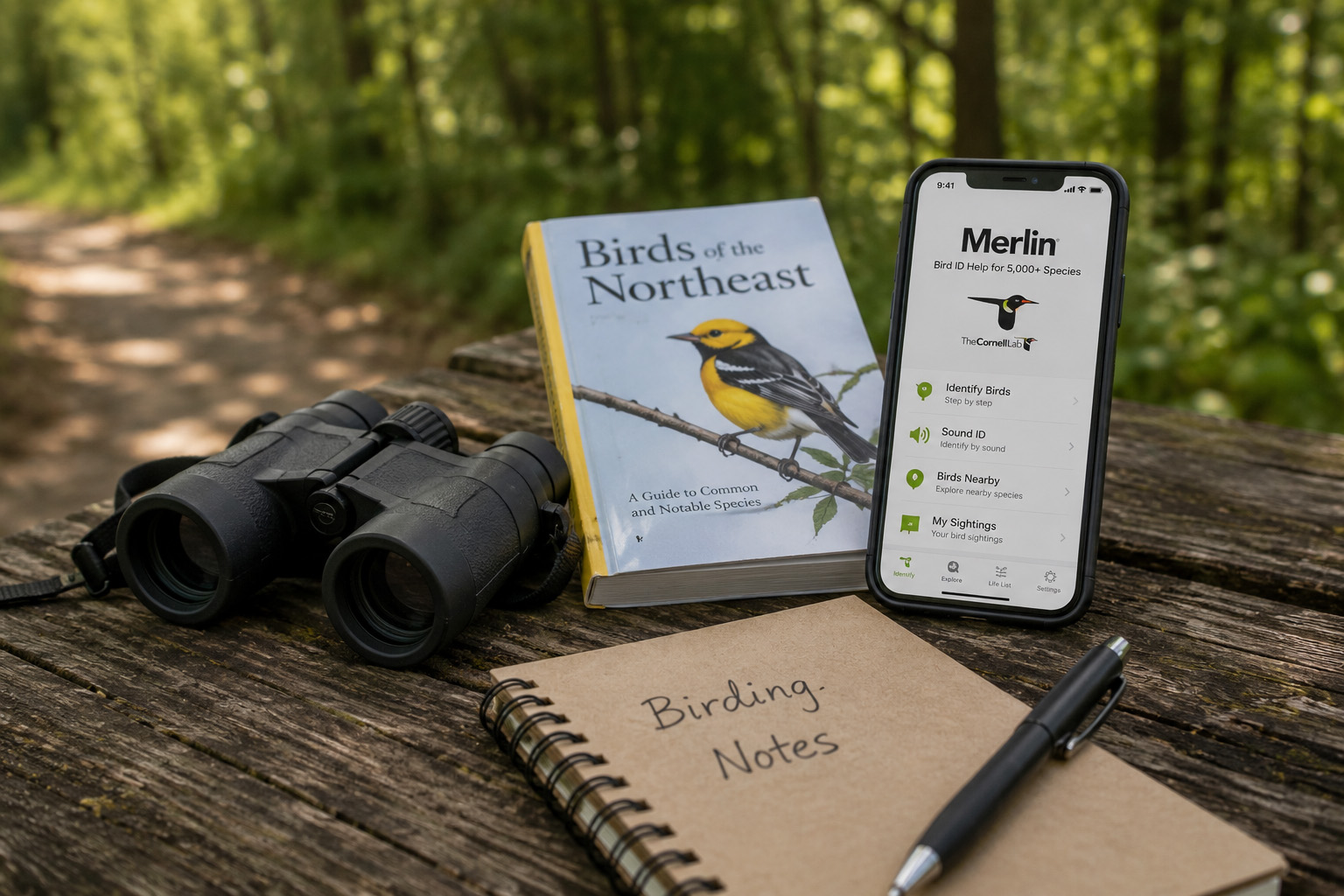
Part two of Fledgling Files — a blog series for new birders who are figuring this whole thing out, one sparrow at a time.
Picture this: you’ve decided to get into birding. You’re excited. You’re ready. You walk into an outdoor sporting goods store and head for the binocular wall.
Forty-five minutes later, you leave empty-handed, slightly dazed, and $0 poorer — because the entry-level pair looked flimsy, the mid-range pair had mixed reviews, and the salesperson casually mentioned that “serious birders” use something that costs more than your first car.
So you go home and do more research. You join a birding forum. You read seventeen threads comparing lens coatings. You bookmark a pair you can’t quite justify. You tell yourself you’ll start birding once you have the right setup.
Reader, this is the trap. And it has caught nearly every new birder who has ever lived.
Your Eyes Are the Point
Here’s the uncomfortable truth the gear industry doesn’t want you to know: the most important birding tool you have is your ability to slow down and pay attention. No amount of optical glass can teach you that.
Ask any experienced birder what separates beginners from intermediate birders, and they won’t say “better binoculars.” They’ll say things like:
- Knowing which habitat a bird prefers
- Recognizing behavior — how it moves, how it feeds, how it flies
- Learning songs and calls, which often ID a bird before you even see it
- Developing a search image — the brain’s ability to pick out a familiar shape from visual noise
All of that is built in the field, through time and attention. None of it requires a purchase.
The birders who improve fastest aren’t the ones with the best gear. They’re the ones who go outside the most. Frequency beats equipment every single time.
The Honest Gear Starter Kit
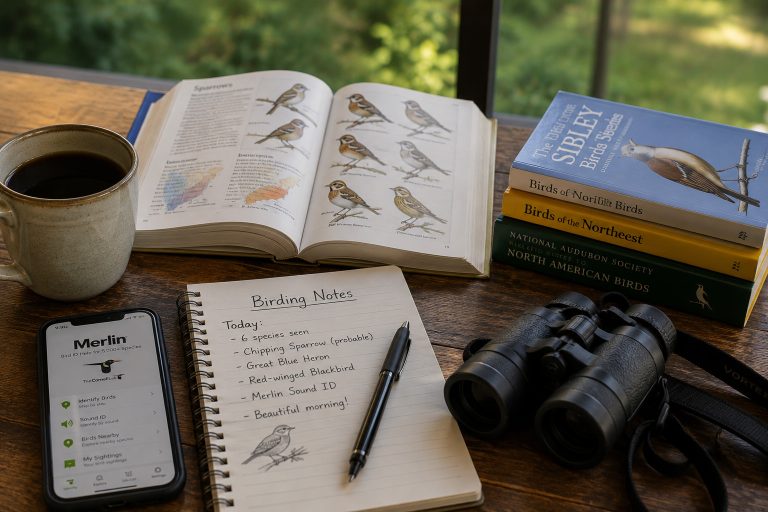
That said — yes, some gear helps. Here’s what actually moves the needle for a beginner, sorted by impact per dollar.
1. A decent pair of binoculars (~$50–$150)
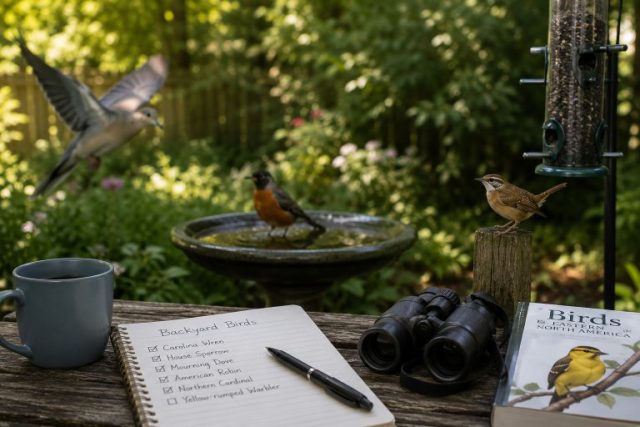
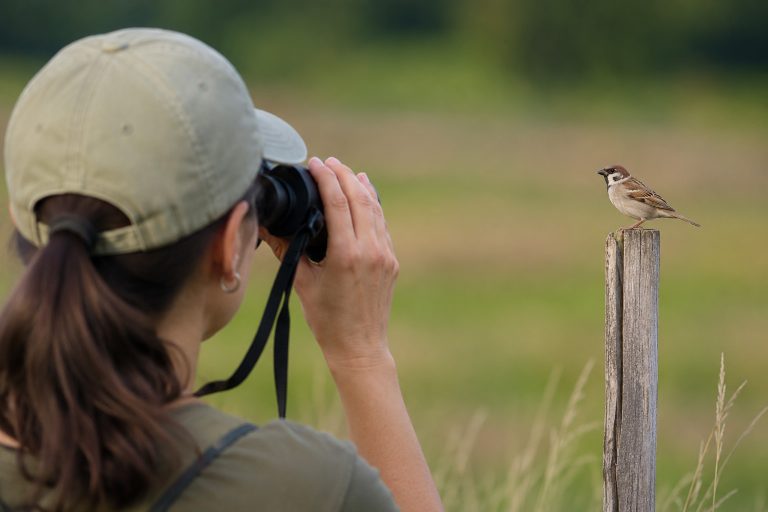
You do want binoculars eventually. But “decent” is doing a lot of work in that sentence. A solid pair in the $50–$150 range — Celestron, Nikon Prostaff, Vortex Crossfire — will show you everything you need to see as a new birder. The dirty secret of the hobby is that a $75 pair you actually carry beats a $400 pair sitting on your bookshelf every single time.
Look for 8×42 as your starting configuration. The 8x means eight times magnification (enough for most birding situations), and the 42mm objective lens lets in plenty of light. Don’t overthink it beyond that.
2. One regional field guide (not the big one)
There are field guides that cover every bird in North America. Do not buy one of these yet. The sheer volume will overwhelm you, and you’ll spend more time flipping pages than watching birds.
Instead, find a guide specific to your region or state. Fewer species, cleaner comparisons, faster lookups. The Sibley guides have regional editions. Many states have excellent local guides written by birders who actually know your area.
3. The Merlin Bird ID app (free)
If there is one genuine game-changer for new birders in the last decade, it’s Merlin, developed by the Cornell Lab of Ornithology. It’s free, it’s excellent, and its Sound ID feature — which listens to birds around you and identifies them in real time — is, frankly, a little bit magic.
Is it “cheating?” Absolutely not. It’s a tool, the same way a field guide is a tool. Use it shamelessly.
The Gear Creep Trap
Once you’ve been birding for a few months, something insidious begins to happen.
You start looking at spotting scopes. You read about digiscoping — attaching your phone to a scope to take photos. You notice that serious birders seem to have a very specific kind of vest with a very specific number of pockets. You browse camera lenses that cost more than a semester of college.
This is gear creep, and it is a universal birding experience. We’re not here to shame you — gear lust is real, it’s human, and honestly, some of that stuff is genuinely cool.
But here’s the honest check-in: are you looking at gear because you’ve hit a real limitation in the field? Or are you looking at gear because it’s easier than going outside?
A spotting scope is genuinely useful if you’re regularly watching shorebirds across a wide mudflat or scanning a distant hawk roost. It’s not useful if you haven’t yet learned your local warblers. A $2,000 camera lens will not make birds easier to identify. It will just make your incorrect identifications higher resolution.
Time in the field. That’s the thing. The gear can wait.
When to Upgrade (And What’s Actually Worth It)
Eventually — after you’ve been outside a lot, after you’ve gotten frustrated with a real limitation, after you actually know what you’re missing — some upgrades genuinely pay off.
Experienced birders, when pressed, tend to agree on a few things worth spending on when you’re ready:
Better binoculars are the most universally endorsed upgrade. The difference between a $100 pair and a $300–$400 pair (Vortex Diamondback, Nikon Monarch) is real — better low-light performance, sharper edge-to-edge clarity, less eye fatigue on long days. You’ll notice it immediately. But wait until you’re sure you love this hobby before you make the jump.
A good rain jacket — not birding-specific, just waterproof — matters more than people expect. Birds don’t stop moving because it’s drizzling. New birders who don’t have weatherproof gear stop going out when it’s drizzling. Weatherproof gear is a birding investment.
An eBird account — which is free — is genuinely worth setting up early. Maintained by Cornell, it lets you log your sightings, explore what’s been seen near you, and connect with local birders who can point you toward good spots. It also contributes to real scientific data. Your house sparrow sightings matter to someone.
The Whole Assignment
Here’s your homework for today, and it will take exactly as long as you have available:
Go outside. Look up. Find one bird.
That’s it. That’s the whole thing. You don’t need binoculars for this (though grab them if you have them). You don’t need a field guide. You don’t need the right vest.
A crow on a telephone wire counts. A pigeon on a ledge counts. A mystery sparrow in a hedge that you can’t identify counts double, because now you’re curious, and curiosity is the only gear that actually matters.
The $400 binoculars will still be there when you’re ready. The birds are outside right now.
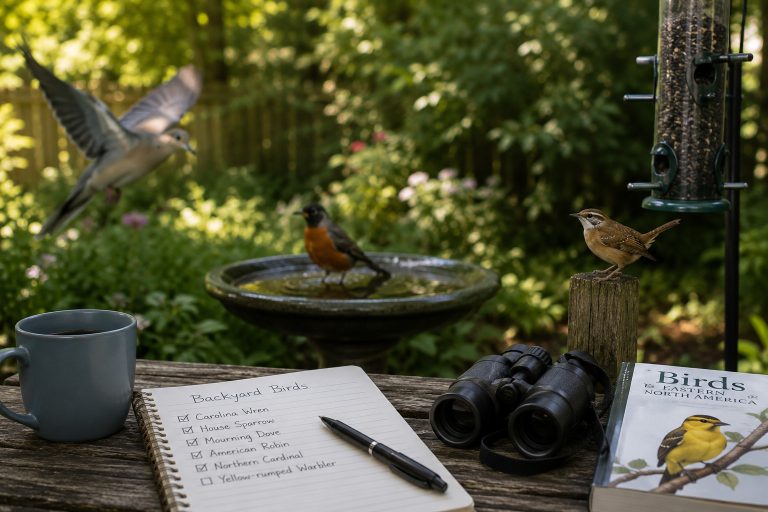
Next up in Fledgling Files: why your backyard might be the best birding spot you’ve never taken seriously.
About The Author