
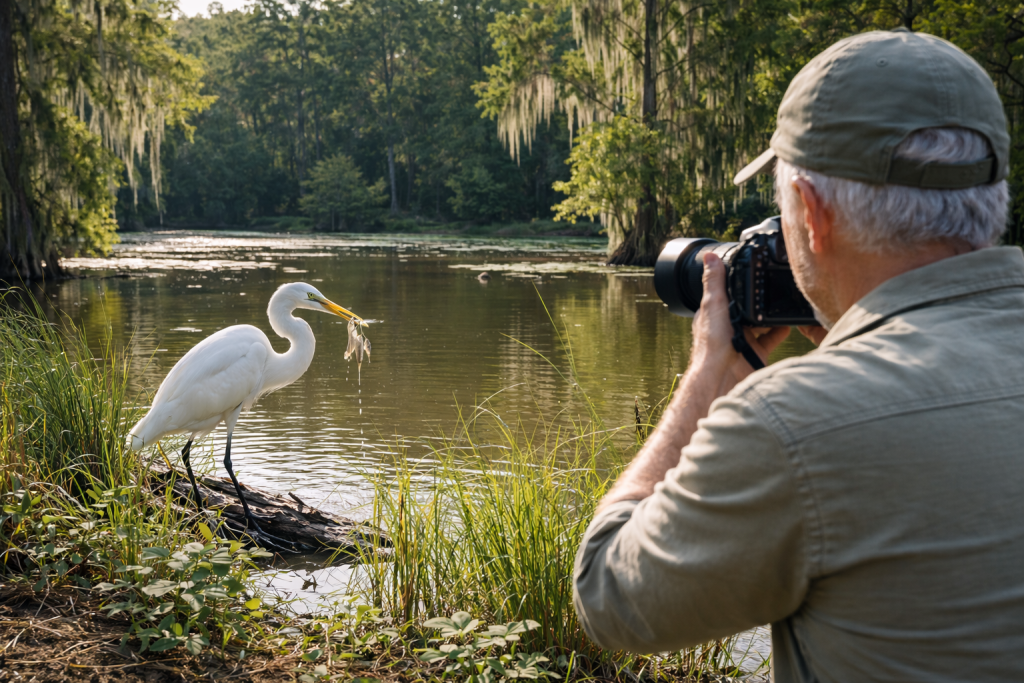
There is nothing wrong with a field guide shot. It is clean. It is sharp. It proves, beyond a reasonable doubt, that yes, that was in fact a Yellow-rumped Warbler and not “some kind of little brown job.”
But if every bird photo we take looks like it belongs on page 47 of a laminated reference book, we are documenting feathers, not personality. And birds, despite their modest brains and questionable life choices during migration, absolutely have character.
If we want to create bird photos that show their character rather than a clinical ID portrait, we must move from documentation to storytelling. We must stop photographing birds as if they are passport applicants and start photographing them as tiny, dramatic protagonists.
Stop Shooting Mugshots, Start Capturing Personalities
A traditional field guide image answers one question: What species is this?
A character-driven image answers: What is this bird up to, and why does it look slightly offended about it?
Instead of centering every bird like it is posing for a yearbook, we begin asking:
- What is the bird doing?
- What mood does this moment suggest?
- Is it hunting, arguing, courting, scheming?
A heron standing still is documentation.
A heron mid-stalk, neck coiled like a feathery spring, is drama.
We shift our goal from “sharp and centered” to “alive and expressive.”
Capture Behavior That Reveals Character
Birds are wonderfully expressive if we pay attention. They puff up when annoyed. They stretch dramatically. They glare at rivals. They scream into the wind as if delivering speeches to invisible crowds.
Character lives in behavior.
We look for:
- Courtship dances that border on theatrical
- Territorial disputes that feel like soap operas
- Feeding frenzies that resemble buffet chaos
- Wind-blown feathers that suggest personality
A puffed-up sparrow defending its twig can communicate more attitude than a perfectly perched specimen.
Timing becomes more important than perfection. We wait. We anticipate. We resist firing 800 frames of a bird doing absolutely nothing.
Use the Environment Like a Stage Set
Field guide photos often eliminate context. Clean background. No distractions. Nothing but bird.
Character photography embraces environment.
Branches frame the subject. Marsh grasses whisper season. Reflections double the drama. Frosted reeds add mood. A splash of sunrise makes everything feel heroic.
A kingfisher against a blank sky is identification.
A kingfisher hovering above glowing water is anticipation.
The habitat becomes the stage. The bird becomes the actor. We compose accordingly.
Master Light for Mood, Not Just Exposure
Midday sun is honest but uninspiring. It tells the truth without telling a story.
Character demands better light.
We seek:
- Golden hour warmth that flatters feathers
- Backlighting that turns wings translucent
- Side lighting that sculpts texture
- Soft overcast that whispers subtlety
Light shapes personality. Harsh shadows suggest tension. Warm glow suggests calm confidence. Rim light suggests cinematic flair.
We are not just exposing correctly. We are directing a mood.
Make the Eye the Emotional Anchor
If feathers are costume, the eye is dialogue.
A sharp eye with catchlight pulls viewers in. A focused gaze suggests intention. A sideways glance suggests suspicion.
Eye level matters. Shooting downward diminishes presence. Shooting at eye level creates a connection. Shooting upward can make even a small bird look mildly intimidating.
When the bird locks eyes with the camera, the image shifts from observation to relationship.
And relationship is where character thrives.
Embrace Motion, Even Slight Chaos
Still birds are easy. Expressive birds move.
Wings mid-stretch. Beaks open in song. Water droplets suspended in air. Feathers caught in the wind.
We use shutter speed strategically:
- Fast for decisive action
- Slightly slower for dynamic wing blur
- Pre-focused for takeoff moments
A perfectly frozen pose may be technically flawless. A slightly imperfect but energetic frame often feels alive.
Motion is personality in action.
Compose for Story, Not Symmetry
The centered bird portrait is safe. Safe rarely equals memorable.
We experiment with:
- Off-center framing for natural balance
- Negative space for solitude
- Foreground blur for depth
- Leading lines that guide the eye
A lone bird surrounded by open space feels contemplative. A tight crop on an intense stare feels confrontational.
Composition is not decoration. It is narrative structure.
Control Depth of Field Like a Director
Shallow depth of field isolates. Deeper depth integrates.
We choose intentionally.
- Wide aperture for intimate portraits
- Moderate aperture to include habitat
- Layered depth for environmental storytelling
Blur is not merely aesthetic. It is emphasis. It tells viewers what matters most.
The background should complement, not compete. We reposition ourselves physically if necessary rather than accepting a distracting backdrop.
A step to the left can save a photograph.
Capture Interaction, Not Isolation
Character amplifies when birds interact:
- Parent feeding a chick
- Two rivals arguing over territory
- A gull confronting its reflection
- A raptor with prey
Interaction adds layers. It creates tension, humor, drama, or tenderness.
These moments are unpredictable, which makes them valuable. We remain alert and ready.
Birds do not schedule emotional scenes. We must be present when they unfold.
Practice Ethical Patience
Character cannot be forced. We never disturb nests or pressure birds for reaction.
We remain:
- Quiet
- Still
- Observant
- Respectful of boundaries
When birds forget we are there, authentic behavior emerges. The best character portraits often come after long periods of simply waiting.
Patience is the invisible ingredient in compelling bird photography.
Use Equipment to Support Expression
Long lenses isolate beautifully. Mid-range telephotos allow environmental storytelling. Fast glass enables subject separation.
Equipment matters, but only as a tool.
The decisive moment, the expressive behavior, the intentional composition—those create character. The lens simply allows us to frame it well.
We invest wisely, but we rely more heavily on observation than on hardware.
Edit With Restraint and Purpose
Post-processing enhances mood without overpowering authenticity.
We:
- Add subtle contrast to reveal feather texture
- Adjust warmth or coolness to reinforce emotion
- Sharpen selectively around the eye
- Control highlights to preserve detail
We avoid turning birds into glowing fantasy creatures. Real personality is powerful enough.
Editing should refine the story, not rewrite it.
Study Species to Anticipate Personality
Different birds express themselves differently.
Raptors carry intensity.
Songbirds bring animated charm.
Shorebirds exude alert precision.
Waterfowl often radiate calm authority.
When we learn their behavioral rhythms, we anticipate peak moments rather than react late.
Knowledge transforms luck into intention.
From Identification to Interpretation
Field guide photos document. Character-driven images interpret.
To consistently create bird photos that show personality rather than static identification, we:
- Observe first.
- Wait for behavior.
- Compose deliberately.
- Use light intentionally.
- Frame for emotion.
- Integrate habitat.
- Capture interaction.
- Edit thoughtfully.
When we shift from proving what species it is to revealing who that bird feels like in that moment, our images become memorable.
We are no longer taking pictures of birds.
We are creating portraits of living, breathing, occasionally dramatic feathered characters.
More Stories
Field Notes From Someone Who Was There
Welcome, Mags – Our Latest Blogger
Texas Birds, No Hurry