
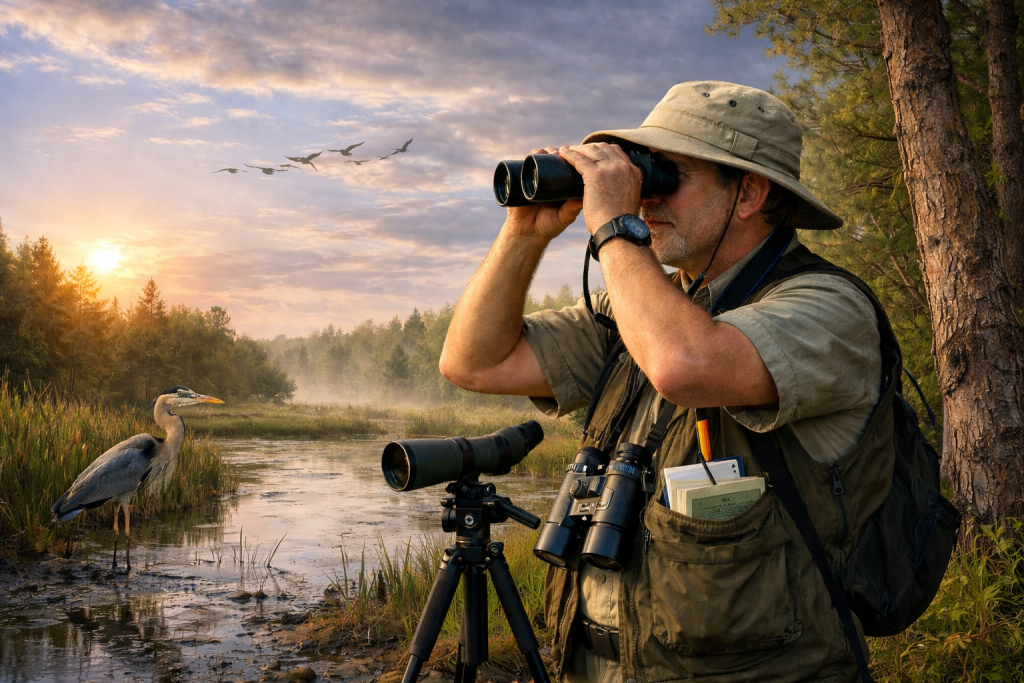
Birding is not a treasure hunt where birds leap into view, waving tiny flags. It is a discipline rooted in awareness, pattern recognition, timing, patience, and environmental literacy. Beginners often walk into a park thinking, “I hope I see something.” Experienced birders walk in thinking, “Given this habitat, wind direction, season, and light angle, I expect to see at least three warblers, a woodpecker, and something that will require a second opinion.”
The difference is not magic. It is a method. With just enough humility to admit that birds still enjoy proving us wrong.
Birds Follow Habitat Rules (Even When They Pretend They Don’t)
One of the first lessons we internalize is simple: birds are loyal to habitat structure.
They do not randomly scatter themselves like confetti. They choose specific vegetation layers, food sources, water access points, and protective cover. When we arrive at a location, we are not merely looking for birds. We are reading the landscape.
Dense brush invites sparrows and wrens.
Open fields host meadowlarks and raptors.
Tall mature forests attract woodpeckers and canopy warblers.
Shallow wetlands draw shorebirds and herons.
A beginner may say, “It’s a lake.”
An experienced birder says, “That exposed mudflat on the north edge is where the action will be.”
Birds respond to structure. The sooner we stop admiring scenery and start analyzing it, the more birds we find.
Timing Is Everything (Birds Own Better Calendars Than We Do)
Birding at noon in August and wondering where the birds are is like going to a bakery at midnight and complaining about the croissants.
Experienced birders understand seasonal movement, migration windows, breeding cycles, and daily activity patterns.
- Spring migration can explode with activity at dawn.
- Fall migration brings different plumages and subtle identification challenges.
- Breeding season fills mornings with song.
- Winter concentrates birds around reliable food and open water.
We also monitor the weather like cautious meteorologists. A favorable wind overnight can bring a “fallout” of migrants. A sudden cold front can push waterfowl into local reservoirs.
Birds move with purpose. If we match their schedule, success increases dramatically.
We Listen First, Because Birds Talk Constantly
Leaves hide birds. Songs reveal them.
Experienced birders rely heavily on sound identification. Before scanning branches, we pause and listen.
We recognize:
- Sharp chip notes of migrating warblers.
- Metallic calls of sparrows.
- Flight calls overhead at dawn.
- Alarm notes that signal predators.
Beginners stare upward, hoping for movement. Experienced birders close their eyes briefly and let the forest introduce itself.
And sometimes, the forest introduces itself loudly enough that we wish we had brought earplugs. Mockingbirds have opinions.
Behavior Reveals Identity Faster Than Color
Plumage changes. Behavior rarely does.
We observe:
- Tail bobbing that narrows options immediately.
- Ground scratching typical of towhees.
- Hovering kestrels holding position in the wind.
- Flycatchers making dramatic sallies and returning to the same perch.
A beginner might say, “It was small and brown.”
An experienced birder says, “It stayed low in dense brush, flicked its tail upward, and scolded me.” That reduces the possibilities considerably.
Behavior is the bird’s signature move. Learn it, and identification speeds up dramatically.
Microhabitats Are Where the Action Happens
Not all parts of a forest are equal.
We search for:
- Dead snags within living canopy.
- Brush piles created by storms.
- Transitional edges between the field and the woods.
- Mud margins as water recedes.
- Flowering shrubs rich in insects.
Within one acre, bird density can vary wildly. Beginners wander evenly. Experienced birders prioritize intelligently.
We are not lucky. We are selective.
Weather Is a Silent Partner in Every Birding Trip
Wind direction, cloud cover, humidity, and pressure shifts influence bird movement.
- Light rain during migration can concentrate birds.
- Calm mornings enhance listening.
- Strong winds alter flight altitude.
- Heat suppresses midday activity.
Instead of asking why birds are scarce, we ask what the weather encouraged them to do.
Birds are practical creatures. They do not perform for our convenience.
Stillness Is Not Laziness
Movement sends birds deeper into cover. Noise disperses feeding flocks.
Experienced birders move slowly, pause frequently, and stand quietly at promising spots. After a few minutes, the environment relaxes. Birds resume activity.
Many beginners leave just before the forest resets and reveals itself.
Patience feels inactive. It is actually tactical.
Mixed Flocks Are Mobile Opportunities
During migration and winter, birds often travel in mixed feeding flocks. Chickadees frequently anchor these moving groups.
Find one chickadee, and you may uncover:
- Warblers
- Kinglets
- Nuthatches
- Vireos
- Woodpeckers
Beginners chase individuals. Experienced birders locate the flock and stay with it.
It is far more efficient to follow the parade than chase confetti.
Structure Over Color, Always
Experienced birders focus on:
- Bill shape and length.
- Wing bar presence.
- Primary feather extension.
- Tail proportion.
- Overall silhouette.
Plumage changes with age and season. Structure remains consistent.
If you can identify a bird in partial shadow by shape alone, your skill has advanced.
Optics Technique Matters
Quality binoculars help, but technique matters more.
We adjust diopters properly. We focus quickly. We keep lenses clean. We raise binoculars smoothly without losing the bird.
There is a brief but crucial moment between spotting movement and confirming identification. Efficiency during that moment determines success.
And yes, we still occasionally lift binoculars only to realize we are studying a leaf.
We Anticipate Instead of React
Birds often move predictably once we observe long enough.
We watch:
- Open canopy lanes.
- Fence lines.
- Shorebird feeding circuits.
- Thermals forming over fields.
Instead of spinning in circles at every flutter, we position ourselves where birds are likely to appear next.
Anticipation feels calm. Reaction feels frantic.
We prefer calm.
Experience Builds Confidence, Not Arrogance
After years of observation, patterns become clearer. We know which lake corner hosts winter loons. We know which grove produces warbler fallouts. We know when to arrive and where to stand.
And yet, even with all that knowledge, birds occasionally disappear entirely for no reason that satisfies us.
Humility is part of the craft.
The Real Difference
The experienced birder combines:
- Habitat literacy
- Seasonal timing
- Sound recognition
- Behavioral awareness
- Weather interpretation
- Strategic patience
- Structural identification skills
We reduce uncertainty. We increase the probability. We read the landscape as a living system.
And when everything aligns, and birds cooperate magnificently, we still feel the same spark of excitement as the beginner who just saw their first bright warbler.
The difference is that we knew where to look.
Most of the time.
More Stories
Texas Birders: Stop Taking ID Shots and Start Capturing Character & Personalities
Field Notes From Someone Who Was There
Welcome, Mags – Our Latest Blogger