AI Isn’t Coming to Birding… It’s Already Here (And That’s Good News)
“Technology is at its best when it helps us spend more time enjoying nature instead of less.”
For many birders, the words Artificial Intelligence immediately bring mixed emotions.
Some people are excited.
Some are skeptical.
Others wonder if AI is somehow going to replace the joy of birding itself.
The good news is that it won’t.
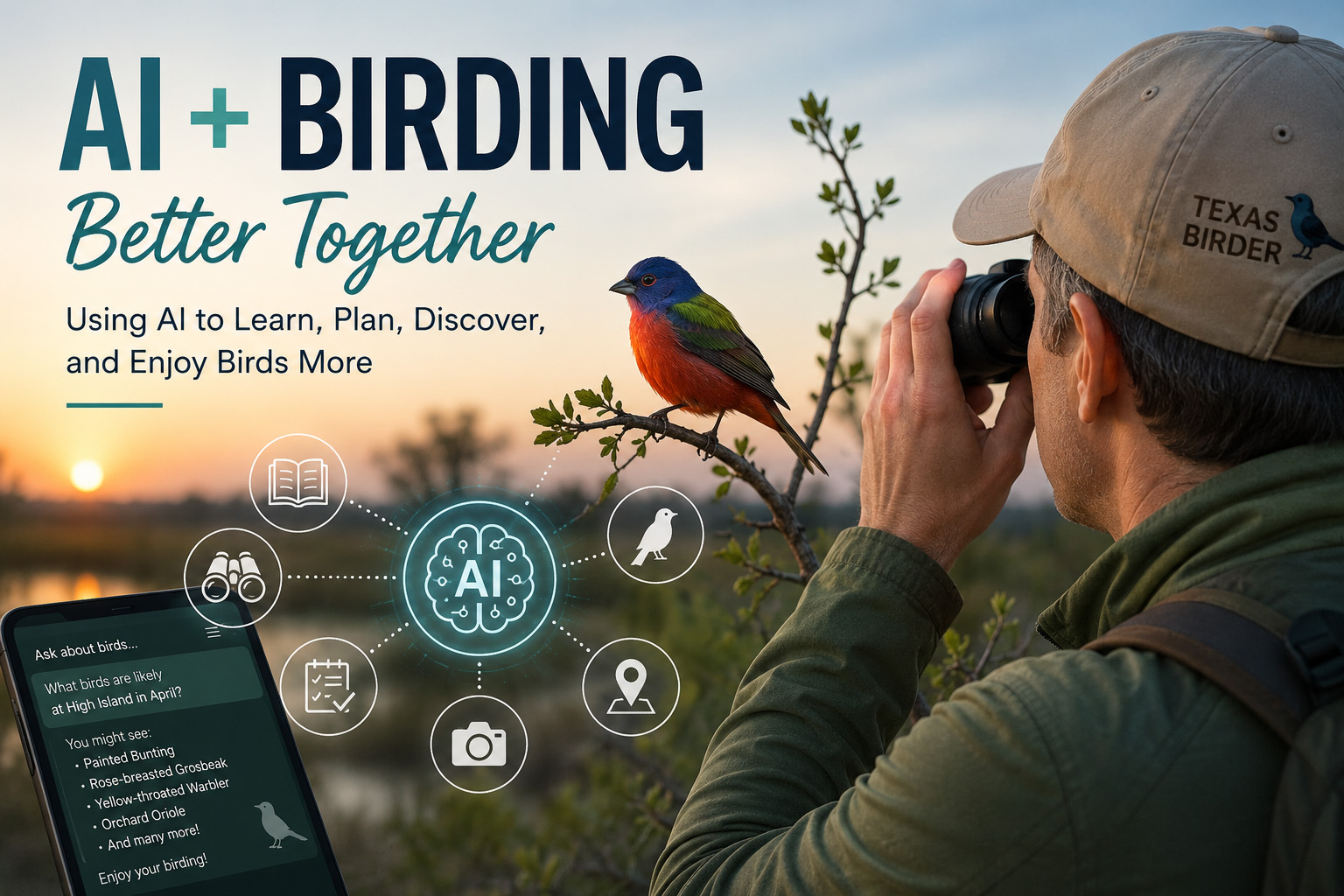
In fact, AI may become one of the greatest tools birders have ever had.
Think of AI as a Really Smart Birding Partner
Imagine having a friend who has read thousands of bird books, studied field guides from around the world, remembers migration dates, knows birding hotspots, can explain confusing identification questions, helps write trip reports, and never gets tired of answering questions.
That’s essentially what modern AI has become.
It isn’t replacing your binoculars.
It isn’t replacing your field guide.
And it certainly isn’t replacing the thrill of seeing a life bird.
It simply helps you become a better birder.
“But I’m Not a Computer Person…”
Neither are many of the people already using AI every day.
If you can send a text message…
If you can search Google…
If you can ask someone a question…
…you can use AI.
There are no complicated commands to learn.
You simply type:
“What shorebirds should I expect along the Texas coast in September?”
or
“Explain the difference between a Lesser and Greater Yellowlegs.”
The conversation begins from there.
AI Doesn’t Have to Be Perfect to Be Valuable
One of the biggest misconceptions is that AI must always be right.
Just like birders, books, websites, and even field guides, AI can occasionally make mistakes.
That’s why experienced birders always verify important information.
Think of AI the same way you think of Merlin, eBird, or another birder giving you advice.
It is an incredibly useful starting point, not the final authority.
How Birders Are Beginning to Use AI
The possibilities are surprisingly broad.
Birders are using AI to:
- Learn bird identification more quickly.
- Understand difficult field marks.
- Compare confusing species.
- Plan birding trips.
- Find likely target species for a location.
- Build packing lists.
- Create personalized birding itineraries.
- Understand bird behavior.
- Learn songs and calls.
- Explain migration patterns.
- Identify habitat preferences.
- Generate photography tips.
- Organize birding notes.
- Summarize research articles.
- Create checklists.
- Prepare presentations.
- Write newsletters.
- Improve social media posts.
- Create educational handouts.
- Develop youth birding activities.
- Generate quizzes and learning games.
- Translate birding information into other languages.
- Help organize clubs and birding events.
And that’s only scratching the surface.
AI for Bird Photography
Bird photographers may discover even more uses.
AI can explain camera settings, the exposure triangle, autofocus techniques, birds in flight settings, lens choices, composition, editing ideas, and even help evaluate why a particular image didn’t turn out as expected.
It becomes a patient instructor that’s available whenever inspiration strikes.
AI for Birding Clubs
Imagine preparing next month’s club presentation in a fraction of the time.
Need ideas for a workshop?
Looking for discussion topics?
Want help organizing a field trip?
Need a beginner handout?
AI can assist with all of those while leaving your own experience and personality front and center.
AI Doesn’t Replace Experience
This may be the most important point of all.
AI has never watched the sunrise over High Island.
It has never stood quietly while a Painted Bunting landed twenty feet away.
It has never smiled when a child spotted their first hummingbird.
Birding is still about being outside.
It’s still about observation.
It’s still about patience.
It’s still about wonder.
AI simply helps you prepare for those moments and understand them afterward.
Think Bigger
Imagine asking:
“I’m going to Richland Creek WMA next Saturday. What birds am I most likely to find? What should I listen for? Where should I spend the most time? What species have been reported recently? What camera settings would work best if it’s cloudy?”
Instead of spending hours searching dozens of websites, you receive one organized answer that you can continue refining with follow-up questions.
The conversation becomes as valuable as the answer itself.
The Future Is Already Here
Artificial Intelligence isn’t replacing birding.
It’s enhancing it.
The birders who learn to use it today will likely spend less time searching for information and more time enjoying birds.
That sounds like a pretty good trade.
Coming Soon…
Over the coming months, Texas Birder will be exploring Artificial Intelligence from a birder’s perspective through articles, practical demonstrations, and presentations designed specifically for birders.
No computer science degree required.
No complicated jargon.
Just practical ways to make birding even more enjoyable.
The goal isn’t to turn birders into technology experts.
It’s to help technology become another useful tool in the birding backpack.
After all, binoculars once seemed like revolutionary technology too.
Perhaps AI is simply the next field guide waiting to be opened.
About The Author